


 126 / 139


| 56
Impressionist & Modern Art
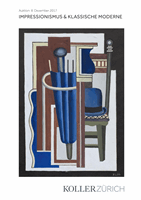
3253 FERNAND LÉGER(Argentan 1881 - 1955 Gif-sur-Yvette)
Nature morte au parapluie et au chapeau
melon. 1926.
Gouache on paper.
Monogrammed and dated lower right:
F.L.26.
38.4 x 28.4 cm.
The authenticity of this work has been
confirmed by Irus Hansma, Muri b. Bern,
23 August 2017. It will be included in the
catalogue raisonné of the works on paper.
Provenance:
- (presumably) Léonce Rosenberg, Paris.
- Galerie Simon, Paris (with parts of the
label on the reverse).
- Private property, St. Gallen, by descent
about 40 years ago.
Bowler hats and umbrellas were essential
components of men's attire at the begin-
ning of the 20th century. In this beautiful
still-life Léger shows us these everyday
companions of the middle-class worker.
The hat rests on a chair, the umbrella in
a stand. The objects are isolated from
one another and only connected by the
colours and the spatial architecture of the
interior setting. From the beginning to the
middle of the 1920s, the work of Fern-
and Léger increasingly moved towards
Purism. He rendered objects of everyday
use – objects possessing a certain social
value – with meticulous sharpness, outside
of space and atmosphere, and detached
from their use.
The shift of the central focus onto the ob-
ject was the direct result Léger's engage-
ment with the medium of film and its new
technical possibilities. In 1924, together
with Dudley Murphy, George Antheil
and Man Ray, he created the important
short film "Ballet mecanique", which was
tantamount to an artistic revolution and
attracted a great deal of attention. Both
Dadaist and Surrealist in character, it had
no explicit script, as explained in an intro-
ductory text at the beginning: "Le Ballet
Mécanique a été composé par le peintre
Fernand Léger en 1924. C’est le premier
film sans scénario." The film starts with a
cubistically arranged figure with cane and
bowler hat with the inscription "Charlot
présente le Ballet Mécanique". Charlot is
the French name of the American social
figure of the Tramp, a character used by
Charlie Chaplin.
In the film, various movement sequen-
ces of figures, objects and machines in
unusual perspectives are shown detached
through multiple repetitions. In doing so,
individual objects are deliberately portray-
ed in unusual clips.
In a lecture delivered before students at
the Sorbonne in 1925, Léger declared: "In
1923-1924, I completed paintings whose
important elements were objects set right
outside any kind of atmosphere and un-
connected with anything normal – objects
isolated from the subjects I had aban-
doned. The subject in painting had already
been destroyed, just as avant-garde film
had destroyed the story line. I thought that
the object, which had been neglected and
poorly exploited, was the thing to replace
the subject" (cited in: J. Cassou and J.
Leymarie, Fernand Léger Drawings and
Gouaches, New York, 1973, p. 87).
"In the years 1926 and 1927, Léger's main
concern was to remove the object from
any compulsion, from its familiar position in
the centre, from the monolithic represen-
tation, and finally to free it completely. […]
This placement of the object, even if at
first sight it may seem arbitrary, is precisely
balanced and worked out. […] Leger, as he
put it, "turned the coffee pot upside down,"
and completely. He "removes the table
which Braque and Picasso have retained,"
and removes the object from its "con-
centric situation, in order to bring it into a
centrifugal position." (Georges Bauquier,
in Schmalenbach/Moeller, Fernand Leger,
Kunsthalle Munich, 1988/89, for no. 22).
There is also a pencil study of this subject
from 1925 (Cassou/Leymarie 1973, no.
124, p. 92) and a painting (Bauquier vol.
III, 1993, no. 462, p. 122) which, like the
gouache, is dated 1926 and which was with
Léonce Rosenberg and Heinz Berggruen
before entering the A. Conger Goodyear
Fund and then the collections of the Mu-
seum of Modern Art of New York in 1959,
where it is still held today.
CHF 80 000 / 120 000
(€ 71 430 / 107 140)